

Industry: Power Generation
Application: Blower Fans
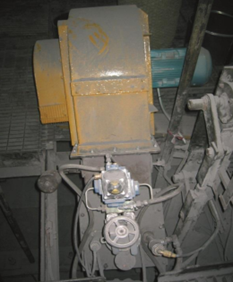
Site Challenge: Aberthaw Power Station in Wales, operated by RWE npower, just west of Cardiff on the north bank of the Bristol Channel, is a coal-fired power station with a capacity of 1,600 MW. To light the coal-fired boilers, the power station uses 36 oil injecting lances on each of its three boilers, with half mounted on each side of the vessel. Oil from the lances is blown into the boiler by fans at two rates – a high flow rate to light the coal and a low flow rate to sustain and support the burn.
The fans were driven by direct-on-line motors, which made it difficult to get the correct oil flow rate required. Kevin Smyth, Assistant Electrical Engineer at the power station, says: “The flame size is dependent on the oil-to-air ratio – too much air and the flame will blow out, while too little air and there is the danger of too much oil entering the boiler, causing potentially dangerous combustion conditions.” As part of an energy saving drive as well as a plan to improve the power station’s environmental credentials, Smyth investigated the possibility of using variable-speed drives to control the combustion air flow. “We looked at several vendors’ products,” says Smyth, “but only the ABB drive had the required robustness we needed. The power station is a very challenging environment with a lot of coal dust and water, so we needed a drive that offered an IP66 enclosure to withstand the dust and the threat of water ingress. We also needed a drive with high heat dissipation, as the drives need to operate in an ambient temperature of 30 degrees centigrade.” APDS were asked for a solution.
APDS Solution: ABB local Drives partner, APDS of Bristol, recommended 7.5 kW ABB standard drives. 32 ABB drives were installed on oil injecting lances with a plan to install 16 more, their location depending on the required oil flow rate at certain points on the boiler.

Benefits:
- Annual energy cost saving of over £350,000
- Accurate controlled flow rate
Outcome: “With the drives, we can run the motors at either of two speeds,” says Smyth. “50 Hz corresponds to the high or normal flow rate, which is used for lighting the boiler. This flow rate will normally be used for 10 hours. The 35 Hz speed is used to maintain a flow rate that sustains the burn. The duration of this can vary depending on the coal type – some are less volatile than others.
Some coal loads may be wet, which can see the low flow rate being used for up to 20 hours a week. As well as saving £350,000 on oil costs, we anticipate that savings could rise even further as oil prices escalate and we are also improving our environmental credentials.”
Footnote:
Please note these customer-approved stories are collected since 2000. While some company names may have changed during this time, the principles and methods described to save energy or improve productivity are applicable today. contact APDS Ltd Bristol: 01179 822 049 www.apds.co.uk
Have a similar project or application? Why not contact us to discuss your needs?